The Cold Never Looked So Blue: Decoding Winter's Strangest Color
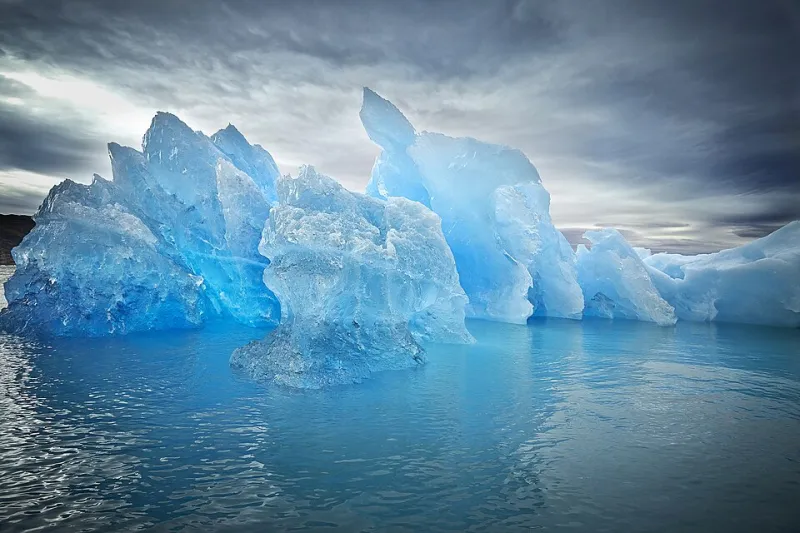
Photo: Visit Greenland from Nuuk, Greenland, CC BY 2.0, via Wikimedia Commons
Ask a child to draw ice and you'll get a white crayon. Ask a glacier guide in Alaska, or anyone who has peered into a frozen crevasse in the Cascades, and they'll describe something else entirely: a blue so saturated it seems lit from within, a color that shows up in no paint chip and no pool tile.
That blue is real, it's physics, and every winter it makes a guest appearance across the northern United States — in ice caves along Lake Superior, in the snow pits dug by backcountry skiers, and in the photographs that come out of frozen Lake Tahoe every January looking almost fake.
Why Water Has a Favorite Color
Start with a claim that surprises most people: pure water is not colorless. It's faintly blue. You can see this yourself with the right setup — a long tube of clean water, or better yet, a white bucket and a very deep pool. (We've covered the bathtub version before; the ocean is the same story at scale.)
Water molecules absorb light, but they're picky about it. They barely touch blue and green wavelengths while quietly sipping away at the red end of the spectrum. Absorb enough red, and whatever light survives to reach your eye leans blue.
The catch is that a glass of water is too thin for the effect to register. The absorption is weak — it takes distance to add up. This is where winter comes in. Ice and snow pack enormous path lengths into a small volume. Light entering a glacier doesn't take the straight route out; it scatters off bubbles and crystals, wandering through the ice for what can add up to many feet before escaping. All that wandering is all that's needed. Red light gets absorbed along the way. Blue light survives the journey and comes out glowing.
Why Snow Is White but Snow Caves Are Blue
Here's the puzzle: fresh snow looks blindingly white, not blue. If water absorbs red, why is a snowbank the whitest thing in the landscape?
The answer is thickness versus depth of travel. Snow is a foam of countless ice crystals and air pockets, and light bouncing through it scatters so many times, so close to the surface, that all wavelengths escape roughly equally. White.
But dig into that snowpack — as avalanche educators do when they dig snow pits every winter across Colorado and Montana — and the walls of the pit turn blue. Once light has to travel deep and far to get back out, the red wavelengths get filtered out and only the cool end of the spectrum remains. The deeper the hole, the more electric the blue. Same reason the inside of an ice cave glows while its snowy roof stays white.
Glacial ice takes it further. Old, compressed glacier ice squeezes out most of the air bubbles, becoming dense and clear — a long, clean optical path. That's why Alaskan and PNW glacier ice reaches the deepest blues, while bubbly, freshly frozen lake ice tends toward a paler, milkier turquoise.
The Laser Sounds of a Freezing Lake
Winter's light show has a soundtrack, and it's stranger than the visuals.
On cold, clear nights in Minnesota, Wisconsin, and the Adirondacks, frozen lakes start making noise — an eerie mix of whoops, chirps, and zaps that people reliably describe as sci-fi laser fire. There are viral recordings of it every winter, and they sound like they can't possibly be natural.
They are. Ice expands as it cools and as new ice forms, building up stress. When that stress releases, cracks race through the ice sheet at high speed. The pitch of the sound depends on the ice thickness and the crack's path, and thin ice over water produces those high, tonal "pew" sounds as vibrations travel through the sheet and radiate into the air. Colder nights mean more contraction, more stress, more lasers.
It's the same physics that makes lake ice booms — those thunderous cracks that rattle windows in ice-fishing country — just at a smaller, higher-frequency scale. Both are the sound of a solid material doing what solids do when temperature swings: adjusting, loudly.
Chasing Blue Hour on the Ice
Photographers have turned all of this into a winter pilgrimage. The window is short: the roughly 20 to 40 minutes around sunset and sunrise, when the sun is below the horizon and the sky's remaining light is blue-dominated. On frozen lakes — Tahoe's boulder-strewn shallows, the sprawling ice of Mille Lacs, the surveyed squares of Lake Superior near Duluth — photographers lie on the surface with wide lenses, shooting pressure ridges and trapped bubbles against a sky that matches the ice.
The results look enhanced. They aren't. The ice really is that blue, especially where light passes through thick, clear sections rather than bouncing off frost. Add the natural bubble trails trapped in lake ice — methane and other gases frozen mid-rise, stacked like champagne columns — and you get images that seem designed rather than discovered.
One practical note, because it matters: the same thin, clear ice that photographs beautifully is the ice that sounds like a laser battle. Ice that's loud is ice that's moving. Anyone venturing onto frozen lakes should check local ice reports, know the thickness guidelines (generally four inches of clear ice minimum for foot travel), and remember that no photograph is worth a crack racing under your boots.
The Same Old Water, Seen Sideways
What ties the glowing crevasse to the laser-pew lake is a single idea: water interacts with light selectively, and winter gives that selectivity room to perform. Give red light a long enough path through ice and it disappears. Give ice a cold night and it sings.
So when the deep freeze arrives this year, take the long way past a frozen pond. Look for the blue in the shadowed side of a snowbank, listen on a still, bitter night, and know that you're watching the same molecule — plain old H2O — running one of its favorite experiments.