Before the Gauge, There Was the Glare: How Americans Read Water With Nothing but Sunlight
Photo: cogdogblog, CC BY 2.0, via Wikimedia Commons
There's a particular kind of knowledge that doesn't get written down in manuals, because the people who had it never needed a manual. Ask an old-time flatboat pilot how he knew where the channel ran on the Mississippi, and he might have told you something strange: watch the water's face. Not the banks, not the current sticks drifting by — the light itself.
It sounds like folklore. It's actually physics, and for roughly two centuries of American history, it was the most advanced technology on the river.
The Water's Face Tells the Truth
Start with the basic principle. A calm water surface acts like a mirror, obeying the law of reflection: light bounces off at the same angle it arrived. But water almost never sits still, and that's where things get interesting. Wind ripples, upwelling currents, submerged obstructions — all of them wrinkle the surface, and each wrinkle scatters reflected light in a different direction.
To a trained eye, that scattering is a readable text.
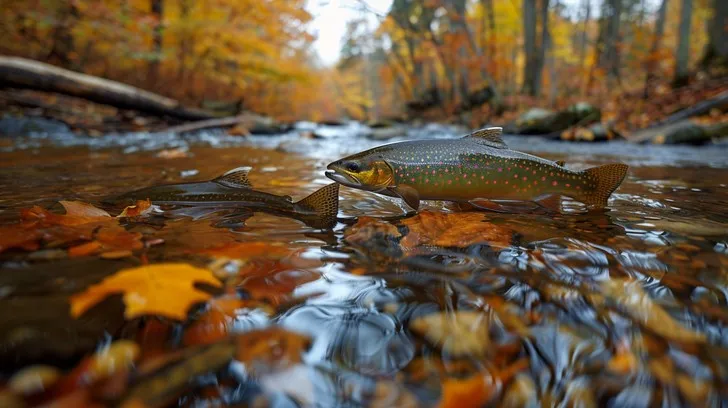
A smooth, glassy patch in an otherwise rippled river often marks a deep, slow-moving channel — the water below isn't turbulent, so the surface stays flat. A line of choppy, glittering water, by contrast, can mark a shallow bar or a submerged rock, where the current piles up and breaks the surface into confetti. Rivermen called these patterns by name. They read the riffle and the slick the way a modern pilot reads a depth sounder.
The sun glint itself was an instrument. When the sun sits low, its reflection stretches across the water toward you in a long, blazing path. Broad, broken glitter means a rough, shallow or wind-whipped surface. A tight, concentrated glint path can indicate smoother, deeper water aligned with the reflection angle. Sailors on the Chesapeake and the Great Lakes used the same logic to find wind — dark patches on the water are gusts arriving, visible minutes before they hit your sails, because the arriving wind roughens the surface and changes how it reflects the sky.
Ice, Clarity, and the Folk Optics of Winter
The techniques didn't stop at liquid water. Farmers and teamsters crossing frozen creeks in the Midwest learned to judge ice safety partly by its optical character. Sound, thick ice often has a certain clarity and a particular ring underfoot; gray, opaque, or honeycombed ice scatters light differently because it's riddled with air pockets and cracks — literally a different material optically. Nobody was measuring refractive indices at the creek crossing, but they were reading the results all the same.
Water clarity worked similarly. Pioneers heading west learned that a river running chocolate-brown after a storm carried heavy sediment load — and often, dangerously, that its depth and channels had shifted overnight. A river running clear and green-tinted was stable, its bed settled. The color was a report card on the whole watershed, delivered free of charge.
The Physics Underneath the Folklore
Strip away the dialect and every one of these techniques reduces to a principle you'd meet in an introductory optics course:
- Specular vs. diffuse reflection. Smooth surfaces mirror; rough surfaces scatter. Surface texture is a proxy for what's happening below.
- Refraction at the boundary. Light bends as it enters water, which is why a clear shallow stream shows you its pebbles while a deep one shows you only reflection. Seeing bottom versus seeing glare is a crude but genuine depth gauge.
- Absorption and scattering in the water column. Sediment, tannins, and algae each tint the water's reflected light differently, turning color into a chemistry readout.
In other words, two hundred years of practical American watercraft were, functionally, a distributed optical sensing network with no equipment at all.
Did We Lose Something When We Stopped Looking?
Here's the uncomfortable part. Today a kayaker checks an app for the gauge reading. A farmer consults a satellite soil-moisture index. These tools are wonderful — more accurate, more consistent, available in the dark.
But instruments answer only the questions they're built to ask. The old water watchers noticed things no sensor was looking for: the odd slick where a spring fed in, the glint pattern that said a channel had moved, the sheen on the creek that meant something upstream had changed. They noticed because noticing was the job.
We'd argue the answer isn't to put the sensors away. It's to remember that the water's surface is still broadcasting, constantly, in reflected light — and that anyone can learn the language. Next time you're on a river, a lake, even a flooded parking lot after a storm, take a moment and just look at what the light is doing. The water has been talking this whole time.
We just stopped listening.