Now You See Them: Five Ways Freshwater Animals Weaponize Light
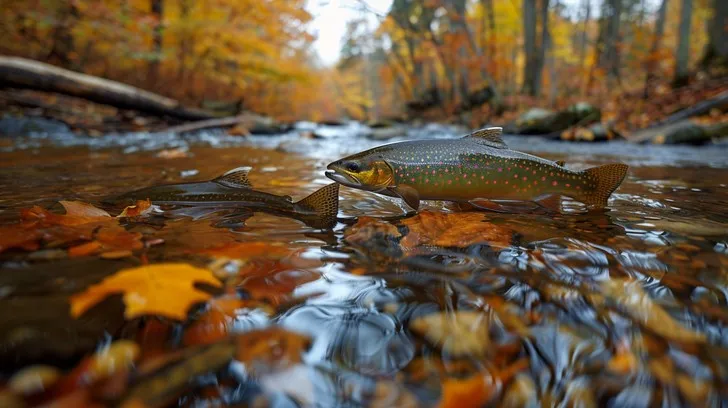
Photo: brook trout camouflaged in clear shallow creek streambed, via images.stockcake.com
Peek into any creek, pond, or aquarium tank and you're watching an arms race that's been running for millions of years. The weapons aren't teeth or claws so much as photons. American freshwater animals have evolved to exploit every quirk of how light behaves in water — bending, scattering, dimming with depth — and once you know what to look for, the water stops being a tank of fish and becomes a gallery of optical illusions.
Here are five of our favorites, each powered by a different trick of the light.
1. The Trout's Two-Tone Disguise
Grab any field guide to brook trout, rainbow trout, or largemouth bass and you'll notice the same pattern: dark on top, pale underneath. Biologists call it countershading, and it's a direct answer to how sunlight behaves underwater.
Light comes down. That's the whole problem. A fish lit from above casts its shadow downward, and against bright surface water seen from below, a uniformly dark fish would stand out like a silhouette in a spotlight. So the trout's back is speckled and dark to blend with the streambed when viewed from above, while its pale belly matches the bright, sunlit surface when viewed from below. Look up at a trout from underwater and its belly essentially vanishes into the glow of the sky filtered through the surface.
Countershading isn't unique to fish — it shows up in deer, penguins, even caterpillars — but in clear streams you can watch it working in real time.
2. The American Shad's Living Mirror
Some fish don't bother blending in. They become the background.
The American shad, an anadromous fish that runs up East Coast rivers every spring, carries highly reflective scales along its flanks that work like biological mirrors. Underwater, most of the light arriving from the side is scattered sunlight — coming from every direction at once, with no single bright source. A vertical mirror in that kind of light reflects roughly the same scrambled brightness as the water around it.
The result: a shad viewed from the side is a shimmering non-object. It doesn't match the background so much as reproduce it. Open-ocean fish like herring use the same strategy, and it's arguably the most effective camouflage on Earth — no pigment required, just good optics.
3. The Crayfish That Matches Its Water
Clear Ozark streams and Appalachian creeks are famous for crayfish that seem painted by the rocks they live on. And they are — evolutionarily speaking.
In clear water, visual predators like herons, bass, and raccoons hunt by sight, so crayfish under that selection pressure trend toward mottled browns and greens that mimic gravel and leaf litter. In muddy or tannin-stained water — think the blackwater creeks of the coastal Southeast, tea-dark with dissolved plant tannins — light barely penetrates, and camouflage stops mattering. Those crayfish often come in pale or even bright colors.
The optics lesson: water clarity itself is a selective force. Change how far light travels through a creek, and you change what colors survive.
4. The Snell's Window Escape Plan
Here's the strangest one. From underwater, looking straight up, you see a circular window of bright sky — the entire hemisphere of the world above, compressed into a cone about 97 degrees wide. It's called Snell's window, and it exists because of refraction at the surface.
Prey fish know this window matters. Predators like ospreys and kingfishers strike most effectively when their target is inside that cone, where the fish's image can actually reach the bird's eye through the surface. Outside the cone, the surface acts like a mirror from below, reflecting the streambed instead — and a fish hiding at the edge of the window is, from the hawk's perspective, effectively behind glass.
Small fish school and dart with this geometry in mind, staying at depths and angles where the surface betrays them least.
5. The Bluegill's Polarized Poker Face
Light reflecting off a water surface becomes partially polarized — its waves vibrate in a preferred direction. Some fish, including bluegill and several baitfish species, have scales and skin that reflect polarized light in adjustable ways.
Researchers studying these fish suspect they use this to fine-tune their apparent brightness against the polarized glow of the sky above — a kind of brightness dial no human eye can even perceive, since we can't detect polarization without sunglasses and a bit of training. Fish with polarization vision, which includes trout, can potentially spot prey that looks perfectly camouflaged to us.
In other words, some of the best camo in the creek is camo we can't even see the point of.
Look Closer Next Time
None of this requires a research vessel or a microscope. A pair of polarized sunglasses, a creek bank, and ten patient minutes will show you countershaded bass holding in the shade, a crayfish indistinguishable from the gravel it sits on, and — if you're lucky — a kingfisher testing Snell's window for itself.
Light and water set the rules. Everything swimming down there has spent a few million years learning to break them.