Bridge Lights, Bug Swarms, Fish Shadows: A Night Walk Along an Urban River
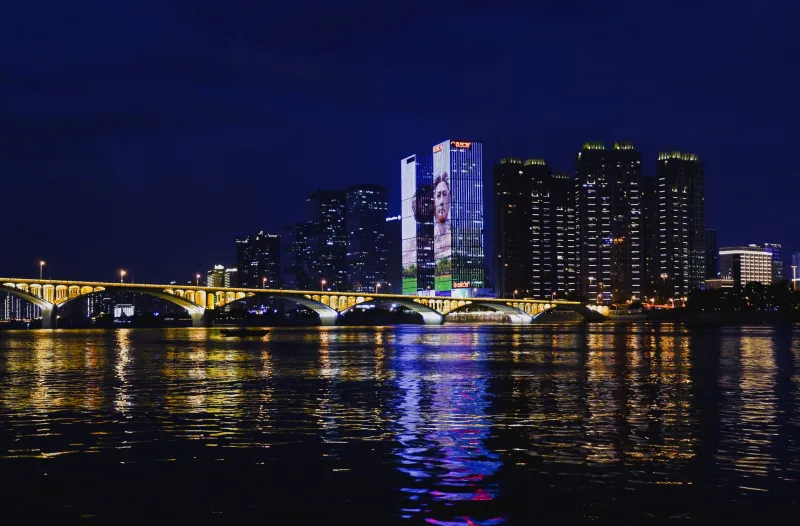
Get to a river in an American city about half an hour after sunset. Not the scenic overlook with the floodlights on, not the festival plaza. Find a spot where a bridge crosses, or where a row of streetlights runs along the bank, and stand where you can see both the lit water and the dark water downstream.
Wait. Your eyes will adjust in fifteen or twenty minutes. Then start looking for the five effects below. They are easy to see, and each one is a small window into a real, measurable problem: artificial light at night is not just a nuisance for stargazers. It is a pollutant with optical properties, and it lands on rivers that are already working hard.
5. The hatch gets hijacked
Aquatic insects time their emergence carefully. Mayflies, caddisflies, and midges spend months underwater as larvae and then rise to the surface, split their skins, and fly — a burst of protein that fish, birds, and bats all count on. Many species use the moon and the horizon glow as a compass.
A lit bridge overrides that compass. Insects spiral toward the lamps in numbers you would not believe, and they die there — exhausted, burned, or picked off by spiders that build webs under ballpark and bridge lighting on purpose. Look for the ring of spiders and swallow nests around any bright riverside fixture. It is a food web built entirely out of a design mistake.
Pay attention to where the light falls, too. Insects are drawn to the halo above the water, and the ones that tumble in become a midnight snack for whatever is waiting below.
4. The polarization trap
This effect is invisible until you know the trick. Many aquatic insects find water by hunting for horizontally polarized light — the signature of a reflective surface, and a very reliable cue for a billion years of evolution. Unfortunately, dark asphalt, car windshields, wet parking lots, and black plastic sheeting all reflect light the same way. They are thousands of times brighter than a pond.
At night, glare from a wet road or a glass-fronted building near the river can pull egg-laying insects away from actual water and onto surfaces where their eggs will dry out. Watch a stretch of riverside pavement under a light and see if insects are hovering over it the way they hover over the river itself. You are watching a supersized optical signal beat the real thing.
3. Fish shadows get longer, and so does the risk
For small fish, dusk is a shift change. Species that hide by day often move into open water at night to feed, relying on dimness as cover. Artificial light narrows that window. Predators that hunt by sight — largemouth bass, walleye at the edges of the light cone, herons and night herons — get a personal spotlight on the shallows.
The result can be a compressed, anxious habitat: fish crowding into darker pockets, avoiding whole reaches of river that happen to be well-lit. If you have ever seen a lamplit stretch of water that looked oddly empty while a dimmer stretch ten yards away rippled with activity, you may have been watching exactly this.
2. Drift goes quiet
Under natural darkness, a huge amount of river life moves: tiny invertebrates drift downstream in the current by night and hold position by day, a rhythm tied to moonlight. Artificial light suppresses that drift, and the suppression ripples outward into growth rates, fish feeding, and nutrient cycling.
This is one of the better-documented consequences of light at night in fresh water, and it is nearly impossible to eyeball directly. But you can set up the experiment. Compare two similar riffles, one under a streetlight and one in the dark, and shine a red-filtered flashlight (red light disturbs aquatic animals far less than white) on the water surface for a minute. Note the number of small swimmers. Do it in both places. It is crude science and it is your own small dataset, which is the best kind.
1. The green-up under the glow
Finally, the effect that changes the river's foundation. Light is fertilizer for algae. Add continuous illumination to a shallow urban waterway and the periphyton — the slimy, diatom-rich film that coats rocks and pilings — has essentially been given a longer growing season. Studies of artificially lit freshwater reaches have reported increased algal biomass and altered community makeup beneath the lights.
Find a bridge with a lamp that stays on all night and look at the submerged rocks directly in the beam versus a few feet outside it. Bring a soft brush and a white tray if you want to get quantitative. The difference is often visible as a darker, thicker fuzz.
What to do with all this
None of these effects requires a research permit to notice, and all of them point the same direction. Lighting levels are a choice, and so is the spectrum. Blue-rich white LEDs are the most disruptive to insects and to the rhythms of fish, while warm-toned, well-shielded, downward-aimed fixtures dramatically reduce spill.
So next time your city proposes new lights on a riverfront trail, you have a specific thing to ask for: shielded lamps, warmer color temperatures, motion sensors, and off switches after midnight where safety allows. You can also just go look. Bring a friend, a red flashlight, and twenty quiet minutes. Rivers at night are not empty, and the light you add to them is a chemical-free contaminant that never washes downstream.