The Turquoise Lie: What the Great Lakes Are Saying When They Turn Clear
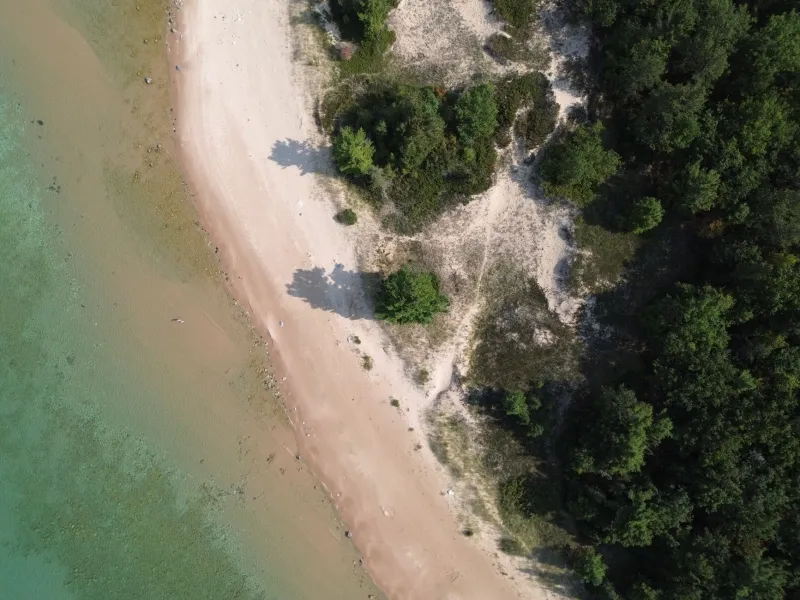
Stand on a Lake Michigan beach in late summer and something feels off. The water is turquoise. Not the pea-soup green your grandparents described, not the milky gray that shows up in old postcards — turquoise, the color of a rental-car brochure for Cancún. People post it. People wade in to their knees and take photos. And almost nobody asks the obvious question: what had to die, or at least disappear, for a lake to look like this?
This is not a story about how to feel. It is a story about a sunbeam. Follow it down and you can see, in fairly literal terms, how a change in optics cascades into a change in ecology — and why clarity is one of the worst possible things to use as a scorecard for a lake's health.
The light budget of a lake
Sunlight entering water is a budget with three line items. Some of it scatters off particles and comes back at you, which is what your eyes read as color and turbidity. Some of it is absorbed by water itself, which is why red drains out first and the deep end looks blue. And some of it travels downward, where algae and plants turn it into sugar.
That third line is why clarity matters so much. The depth at which light falls to about one percent of its surface value is the boundary of the sunlit zone, and everything that photosynthesizes has to live above it. When that boundary moves down, the lake's floor gets bigger as a habitat — and in the Great Lakes, the floor is where the trouble lives.
A filter that changed the architecture
Zebra and quagga mussels arrived in ballast water and spread through the basin over the past few decades. A single quagga can filter a liter of water a day, and they settled by the billions on rocky bottoms, piers, and each other. Their collective effect is like installing a whole-lake water-treatment plant without asking the residents.
Phytoplankton — the drifting microscopic algae that make a lake look cloudy and, more importantly, feed everything else — got strained out. Offshore optical readings that hovered in the single digits of meters in the 1970s and 1980s have, in some areas, doubled or tripled. Satellite images of the lakes now show patches of open water that look like open ocean.
The mussels also rewrote the plumbing. They pull nutrients out of the water column and deposit them on the bottom as feces and pseudofeces, a shortcut called the benthic shunt. Nutrients that used to drift and feed mid-water life now pile up in the shallows, where the light is brightest anyway.
Why clearer water heats differently
Here is the part that surprises people. Particles are not just visual clutter; they are tiny absorbers of heat. Cloudy water spreads solar energy across a thin top layer, where wind and evaporation can carry it away. Clear water lets light punch deeper, delivering warmth well below the surface and, in the case of the Great Lakes, onto the bottom itself.
More radiation reaches the lakebed. That matters because a sunlit bottom is a photosynthesis machine with no shade. Filamentous algae of the genus Cladophora — a native green alga that has always grown on rocks in the shallows — now attaches in water far deeper than it used to reach, sometimes thirty feet or more down. When it dies and sloughs off, it washes up on beaches in windrows and rots, bringing bacteria, smell, and closed-beach signs to shoreline towns whose water looks, from a dock, immaculate.
Thermal structure shifts too. Deeper light penetration can warm the lower layer of a stratified lake, nudging the whole system's timing: when the lake separates into warm and cold layers, when it mixes again in fall, how long the cold-water fish have in their preferred band. None of this shows up in a photograph. All of it shows up in a fishery.
Turquoise is a chemical confession
There is a second reason the lakes glow. In summer, parts of Lakes Michigan and Huron precipitate calcium carbonate out of the water — a fine, milky snow of mineral crystals nicknamed a whiting. Those particles scatter light efficiently and bounce blue-green wavelengths back at the sky. A clear lake with a high mineral load looks luminous. A clear lake also simply looks blue, because water absorbs red light over the first few meters and leaves the cool end of the spectrum to come back to your eye.
So the turquoise is not a lie in the sense that it is manufactured. It is a lie in the sense that we read it wrong. The postcard color is the optical signature of an ecosystem that has lost much of its suspended life.
What clarity does not measure
A Secchi disk — that black-and-white circle lowered on a rope — measures how far you can see, which is a measure of particles. It does not measure phosphorus loading, dissolved oxygen, toxin-forming cyanobacteria in bays, or whether the fish that used to eat plankton still have anything to eat. In the Great Lakes, the decline of the burrowing amphipod Diporeia, a shrimp-like staple of the food web, tracked the mussel invasion closely, and the consequences rippled up toward alewives, whitefish, and the birds and anglers that rely on them.
A lake can be stunning and starving at the same time. Those of us who live near these shores have a habit of treating appearance as evidence. It is time to flip that reflex: in the Great Lakes, a sudden jump in clarity is one of the most reliable early signals that something structural has changed. Use the color as a question, not a verdict. Then go find the numbers — chlorophyll, phosphorus, oxygen, temperature profiles — that tell you whether the lake is actually alive.
The sunbeam will always tell you where the light goes. It is up to us to ask what it left behind.