Water as a Widget: Five Times American Engineers Bent Light On Purpose
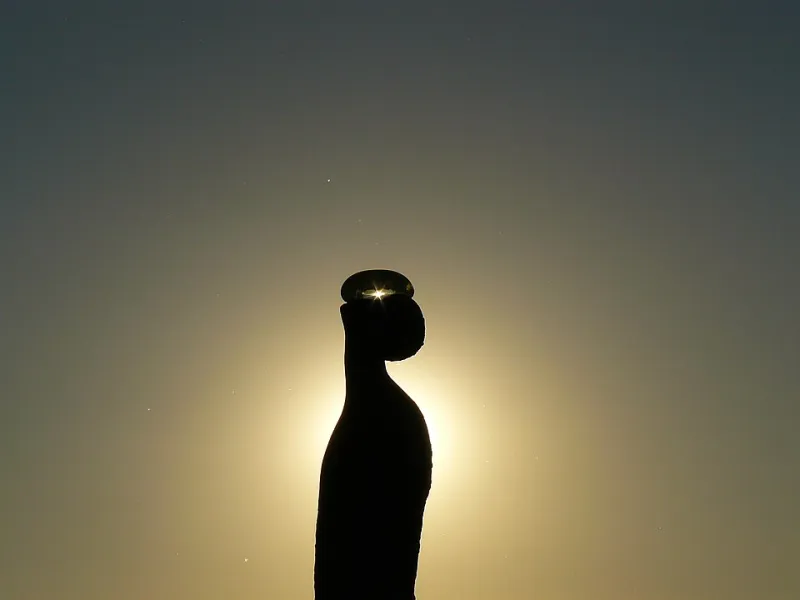
Photo: Chizhik pizhik, CC BY-SA 4.0, via Wikimedia Commons
Puddle shimmer, the bent straw, the pool that looks two feet shallower than it is — most of the time, refraction is the background noise of everyday optics. But walk through the right museum, intersection, or solar array, and you'll find people who decided the noise was actually the signal. Here are five places where American engineers made water's light-bending habit load-bearing.
1. The Lens on the Pavement: Liquid-Filled Traffic Calmers
Speed bumps slow cars with discomfort. A newer idea slows them with doubt. Several US cities have piloted speed-compliance installations that use retroreflective sheeting and water-based prismatic elements — lane markings and signage whose effective optics change with the viewing angle, so a marking that looks flat to a slow driver stretches and distorts for a fast one approaching at a shallow angle. The underlying trick is the same one that makes a wet road glow at night: light takes different paths through a curved, transparent medium depending on geometry. Designers at university transportation labs, including work out of Oregon State's driving-simulator research, have explored how water-filled and liquid-core elements could make warning optics self-adjusting — no electronics, just physics and a little distilled water.
2. The Water Prism on the Museum Floor
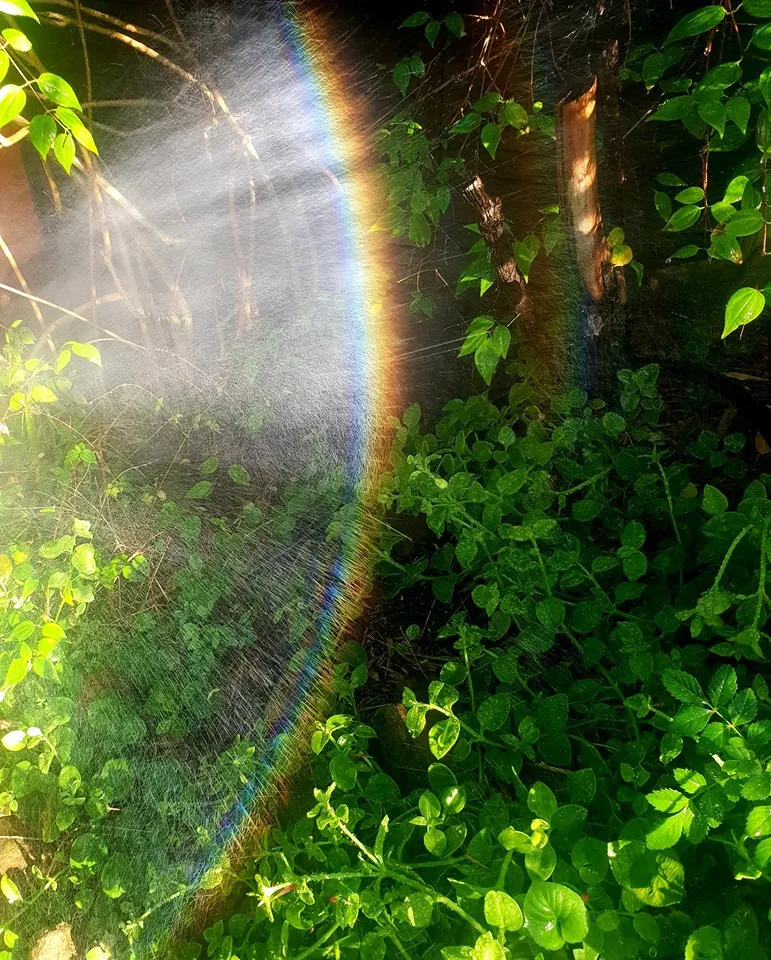
At science centers across the country — the Exploratorium in San Francisco chief among them — the humble water prism has been a workhorse exhibit for decades. Fill a clear, angular tank with water and white light goes in; a spread of color comes out, because water refracts each wavelength by a slightly different amount. The Exploratorium's optics galleries have long used oversized versions where visitors can walk the spectrum's path, watching the dispersion separate and recombine in real time. It's the same physics Newton demonstrated with glass prisms in the 1660s, scaled up so a third-grader can stand inside it. The point the exhibits make, quietly: glass gets the credit, but the dispersive work is done by the liquid.
3. The Periscope That Fills With Ocean
Submarine periscopes use mirrors and lenses, but a related design shows up in a place you might not expect: observation and inspection devices built around water-filled tubes. Because light traveling through a water column meets a refractive boundary at the tube wall, a water-filled tube can act as a crude light guide — total internal reflection trapping rays inside, the same mechanism that carries internet traffic through fiber-optic cable. Engineers and educators have demonstrated this with nothing more than a clear tube, a stream of water, and a laser pointer: the light follows the falling water, curving with it, refusing to escape. It's a demonstration that's run in American physics classrooms for generations, and it's the conceptual ancestor of every optical fiber in the country.
4. Droplets as Solar Concentrators
Concentrating solar power usually means mirrors — big, expensive, precision-ground ones. But researchers, including teams at US universities and national labs, have studied whether water can do the focusing instead. A transparent droplet or a water-filled dome is, geometrically, a ball lens: rays hitting its curved surface bend toward a focus on the far side. Prototype designs have explored arrays of water-filled lenses concentrating sunlight onto small photovoltaic cells or thermal receivers — cheap optical elements made of a fluid that also happens to absorb the waste heat, solving two problems with one bucket. The field is still experimental, but the logic is sound: the lens industry's most abundant raw material comes out of the tap.
5. The Fire Sprinkler's Accidental Light Show
This one is a side effect rather than a design goal, but it's dramatic enough to earn its place. When a fire sprinkler system discharges in a building with high-output lighting — a warehouse, a big-box store, an arena — the falling spray turns the space into a chaotic lens array. Each droplet focuses and refracts the overhead lights, producing strobing caustics that dance across every surface. Lighting designers and fire-safety researchers who study evacuation behavior have noted that this spray-and-light interaction can genuinely affect visibility in an emergency. In ordinary buildings it's a curiosity; in a burning one, it's refraction with stakes.
The Common Thread
Notice what all five have in common: nobody had to invent anything. Refraction, dispersion, total internal reflection — the behaviors were all there, free of charge, in every glass of water. The engineering was mostly a matter of asking the opposite question. Instead of how do we correct for what water does to light?, these projects ask what if water's version of light is the one we want?
That reframing might be the most useful thing on this list. The next time a puddle ruins your reflection or a pool distorts your legs, remember: somewhere, an engineer looked at the same distortion and saw a product.