Why Your Patio Furniture Loses Its Color Before It Loses Its Strength
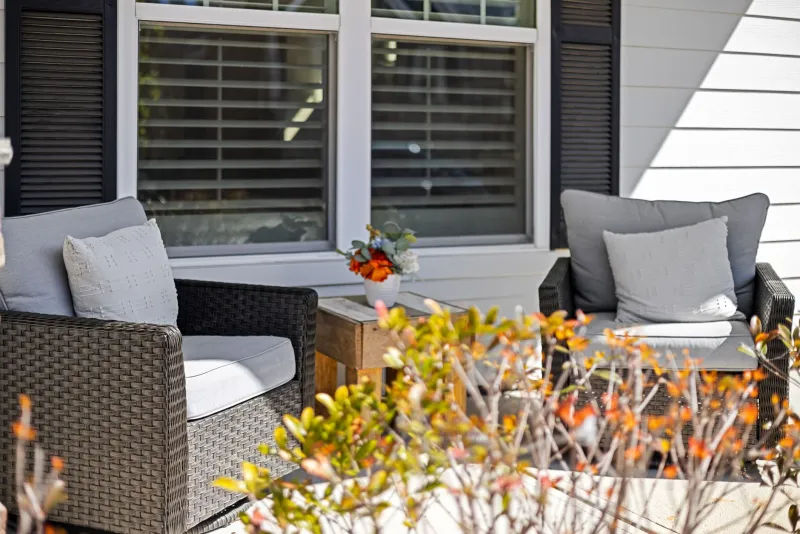
Every backyard has a natural history museum in it. The chair that went from navy to slate. The cushion with a pale stripe where the arm of another chair rested on it. The deck railing that turned chalky white on the south side and stayed brown on the north. None of that is wear and tear from sitting. A lot of it is a chemical reaction, driven by photons, accelerated by water, and easiest to read in the parts of your patio that get the most sun.
The light that does the work
Sunlight arrives as a mix of wavelengths, and the shorter ones carry more energy. Ultraviolet radiation — UV-B, and especially the longer-wavelength UV-A that makes up the bulk of what reaches the ground — packs enough punch to break covalent bonds in organic molecules. Visible light mostly just bounces or gets absorbed as heat. UV starts taking the molecule apart.
The typical plastic in a stacking chair is polypropylene or high-density polyethylene. Those are long chains of carbon atoms with a backbone that should be extremely stable. The problem is that no polymer is perfectly pure. Manufacturing leaves behind trace catalysts and peroxides, and those impurities absorb UV and split into free radicals — reactive fragments with an unpaired electron and an appetite. Once one radical forms, it attacks the neighboring chain and creates another. That is a chain reaction, in the literal sense, and it runs a little further every sunny afternoon.
Chalking, crazing, and the loss of shine
When the chain scission reaches the surface, the result is a powdery, matte film — chalking. You can wipe it off with a thumb and it looks like dust. It is actually degraded polymer, broken into short fragments too small to stay bound to the material beneath.
That chalky layer is why an old chair looks washed out even where the pigment is intact. A smooth surface reflects light in one direction, so a plastic chair catches a highlight and reads as saturated and deep. A roughened surface sends light in every direction, so color gets diluted with white scattered light — a dullness that has nothing to do with pigment and everything with geometry.
Why colors fade at different speeds
Colorants are molecules too, and some are far more vulnerable than others. Azo pigments — common in reds, oranges, and yellows — are notorious for photo-oxidation. Blues and greens often hold out longer, which is why a sun-beaten cushion may turn a peculiar violet as the red component of a purple dye goes first.
You can see this best in fabric. Solution-dyed acrylic outdoor fabric holds color well because the pigment is locked inside the fiber. Printed and piece-dyed fabrics fade early because the dye sits on the surface, where UV gets to it first.
Water is the accomplice
Here is what most people miss: dry degradation is slow. Wet degradation is not. Humidity and rain do several things at once.
- They swell the material. Water infiltrates wood fibers and some polymer matrices, opening microscopic gaps so UV and oxygen reach deeper.
- They enable hydrolysis. Ester and urethane bonds — common in coatings and flexible foams — react with water, and the reaction runs much faster in heat and sunlight.
- They transport the damage. Water carries oxygen and metal ions from dirt and fertilizer into the surface, some of which catalyze radical formation.
- They set up freeze-thaw cycles. Winter is not a rest period. Water in a concrete paver or a wood grain expands when it freezes and pries the material apart from the inside, which is why the damage you notice in June was mostly done in February.
There is a sixth factor, and it is optical: wet surfaces reflect and focus light differently. Standing water and even a heavy dew can concentrate sunlight onto a small area, and snow, which is highly reflective, bounces UV back up at everything above it — under your chair, onto your deck boards, into places your summer sun never reached.
Four tests you can run this week
Even in November there is plenty to observe. Grab a notebook.
1. The droplet test. Put a drop of water on a faded, chalky patch and another on a protected area, like the underside of the same chair. On new plastic the drop beads up like a marble. On a UV-aged surface it spreads out flat, because oxidation has converted the plastic's surface to something water-loving — hydrophilic — and wetting is exactly what you want to avoid.
2. The boundary hunt. Find the line between original color and faded color on a patio cushion. That line is a shadow map. It records precisely where a lamp, a table, an overhang, or a neighboring chair interrupted the sun's path. Photograph it and you have a decent proxy for how much UV that spot received.
3. The tape test. Press a piece of clear packing tape firmly onto a chalky deck board and peel it off. A cloudy white transfer means the surface layer has lost cohesion. Compare with a shaded board. Same wood, different history.
4. The flex and flick. Bend a strip of aged plastic trim and listen. Sun-embrittled polypropylene cracks rather than creaks. It is the same chain scission you saw as chalk, showing up as mechanical failure.
What slows the clock
Manufacturers fight back with UV stabilizers — hindered amine light stabilizers that intercept radicals, and carbon black or mineral fillers that absorb UV before it reaches the polymer. This is why black plastic pipe survives for decades while a white bucket goes brittle in three summers.
For your own patio, the practical version is unglamorous and effective: shade where you can, covers when you cannot, a UV-protective finish on wood, and the realization that a north-facing surface is genuinely a different material from a south-facing one after five years. The next time you carry those chairs in for the season, look at the chalk on your hands. That is sunlight, leaving the building.