The Photon Farm Down the Hall: What Happens When a School Cafeteria Becomes a Greenhouse
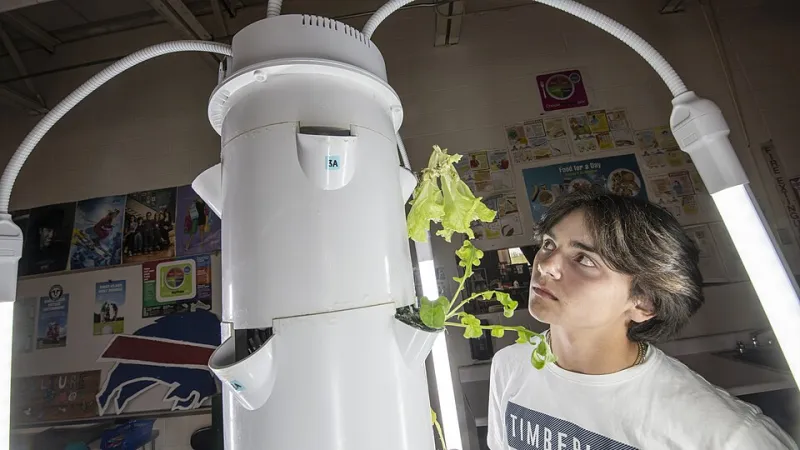
Photo: USDAgov, Public domain, via Wikimedia Commons
Walk into the science wing at a growing number of American high schools and you might do a double-take. Where the biology lab used to be, there's a rack of leafy greens bathed in an eerie magenta glow — rows of lettuce, basil, and kale sipping water from PVC pipes while LED arrays hum overhead. It looks like a sci-fi movie set. It's actually a physics class.
Indoor farming has quietly become one of the most effective hands-on teaching tools in American schools, and not just for the obvious reasons. Sure, students love eating a salad they grew themselves. But the real magic is what's happening in the light — and in the water.
Why Plants Are Snobs About Light
Here's a question worth asking any student staring at a grow light: if sunlight is white and plants thrive under it, why are grow lights purple?
The answer gets at the heart of how photosynthesis works. Plants don't use all wavelengths of visible light equally. Their photosynthetic machinery — pigments like chlorophyll a and chlorophyll b — absorb most strongly in the deep blue range (around 430 nanometers) and the red range (around 660 nanometers). Green light, right in the middle of the visible spectrum? Mostly bounced back. That's literally why leaves look green: they're rejecting the part of the spectrum they can't use well.
So when engineers design LED grow lights, they don't try to replicate sunlight. They aim directly at the absorption peaks. Red photons drive photosynthesis and flowering; blue photons keep plants compact and leafy. Mix them and you get that signature pink glow. A white full-spectrum LED works too, but a chunk of the energy it emits goes out the window — or rather, off the leaf — as unused green light.
For a physics teacher, this is a gift. Students aren't just memorizing that chlorophyll absorbs red and blue. They can run the experiment. Grow one tray under red-heavy LEDs, another under blue-heavy LEDs, a third under white light, and measure the results. Suddenly wavelength, absorption spectra, and the electromagnetic spectrum aren't abstract diagrams — they're the difference between leggy lettuce and a harvest.
The Other Half of the Lesson Is in the Water
Indoor farms are hydrology classrooms in disguise. In a hydroponic system, there's no soil to hold moisture and deliver nutrients — water does all the work, which means students have to understand how water actually behaves.
They learn why nutrient solution needs constant circulation (stagnant water goes oxygen-poor and grows the wrong kind of life). They learn about pH as a real, consequential number, not just a chemistry quiz question. They troubleshoot flow rates through NFT channels — nutrient film technique, where a shallow stream of water runs past bare roots — and discover that a pump running too fast leaves roots dry while a pump running too slow starves them of oxygen.
There's a lovely feedback loop between the two halves of the system, too. Water absorbs light, including the red wavelengths plants want, which is one reason deep water isn't green the way a leaf is. Students who've read our piece on why a glass of water looks faintly blue will recognize the principle: light and water are always negotiating. In a hydroponic classroom, students get to referee.
What's Actually Happening in These Classrooms
Programs across the country have converged on a similar playbook, and it's worth breaking down for any school considering one:
- Start small and cheap. A single shelf unit, two LED bars, a small reservoir pump, and seedlings from the garden center. Many programs run under $500 to start.
- Make data collection non-negotiable. Height, leaf count, water pH, electrical conductivity of the solution, and — if you can borrow a PAR meter — photosynthetically active radiation. Graphs beat lectures.
- Let students break things. The best lessons come from the tray that got too warm, the pump that clogged, the lettuce that bolted under too much red light. Failure is data.
- Connect it to the real world. Hydroponics isn't a gimmick; it's how leafy greens get grown in the Arizona desert and in shipping containers in Brooklyn. Students are running a miniature version of a genuine agricultural industry.
- Feed somebody. The programs that stick are the ones where the harvest goes to the cafeteria salad bar or the local food pantry. Lettuce with a purpose beats lettuce with a grade.
The Bigger Picture
There's something quietly profound about a student adjusting an LED dimmer and watching, over weeks, what changes. It collapses the distance between a physics equation and a living thing. Light is energy; water is the delivery system; the plant is the measurement device. That's the whole story of photosynthesis, and it's running on a shelf next to the vending machine.
The photon farm doesn't need to be big. It doesn't need to be fancy. It just needs a shelf, a spectrum, and someone curious enough to ask why the light is pink. Turns out, that's the easiest question in the building to answer — and the hardest one to stop asking.