The Water We Lose to the Sky
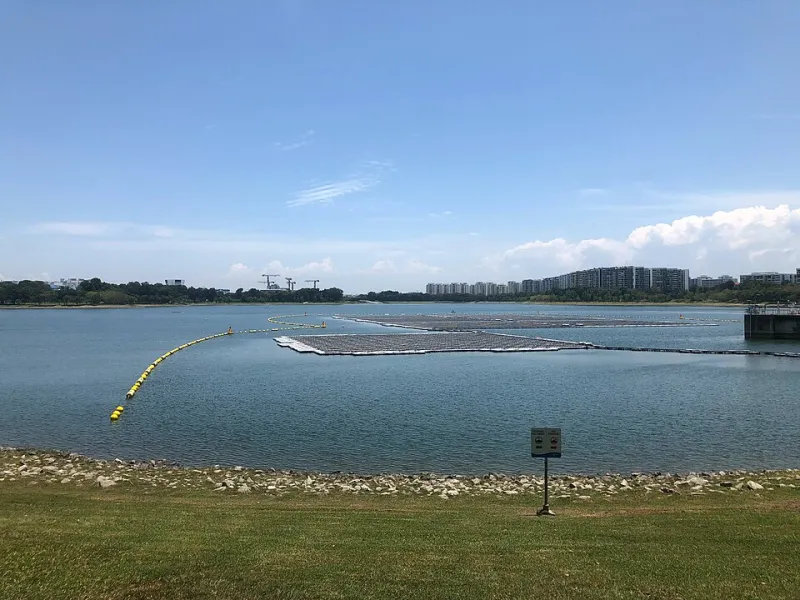
Photo: Wzhkevin, CC BY-SA 4.0, via Wikimedia Commons
Here's a number that deserves more attention than it gets: Lake Mead loses roughly 600,000 acre-feet of water to evaporation in an average year. That's more water than Nevada's entire annual allocation from the Colorado River. It doesn't go to a farm, a city, or a fishery. It goes up.
We spend a lot of energy arguing about who gets to use Western water — agriculture, suburbs, tribes, ecosystems. All fair fights. But there's a third party at the table that rarely gets named: the sky. And in the middle of a decades-long megadrought, maybe it's time we started negotiating with it.
How Sunlight Drains a Lake
Evaporation is the quietest form of water loss because it leaves no trace. No cracked mud, no dropping bathtub ring — just molecules at the surface gaining enough energy from sunlight to break free and float away.
The physics is straightforward. Sunlight warms the water surface. Warm water molecules move faster, and the fastest ones escape into the air. Wind then sweeps that humid layer away, making room for more molecules to escape. It's a conveyor belt powered by two things we have in abundance across the American Southwest: sun and wind.
Scale that up across the region's reservoirs and the numbers get uncomfortable. Estimates suggest evaporation from major Western reservoirs — Mead, Powell, and others — claims on the order of millions of acre-feet annually. For context, that's comparable to the water use of entire states. Los Angeles couldn't drink its way through what Lake Mead quietly loses each year.
And here's the part that stings: unlike almost every other use, evaporation has no constituency. Nobody files a permit for it. Nobody litigates over it. It's simply accepted as the cost of doing business in shallow, sun-baked, open-air bathtubs.
Why We Built the Problem
To be clear, reservoirs weren't designed carelessly. They exist because we wanted water stored where we could reach it. But the way we store it — wide, shallow, and in the sunniest corners of the continent — maximizes the surface area exposed to exactly the conditions that drive evaporation.
Shallow water also heats up faster, and warm water evaporates faster. It's a feedback loop: the lower the reservoir drops, the warmer and shallower it gets, and the harder the remaining water works to leave.
Floating Solar: A Two-Birds Solution
So what do you do about a problem that's powered by sunlight? One increasingly popular answer: block the sunlight.
Floating photovoltaic arrays — solar panels mounted on pontoons that sit directly on the water — have moved from experiment to reality. Japan has deployed them for years on reservoirs and flooded quarries. India, Singapore, and China have followed. The United States has been slower, but projects are surfacing, including installations on water treatment ponds and irrigation reservoirs in California and New Jersey.
The appeal is twofold:
- The panels shade the water, cutting evaporation — studies suggest meaningful reductions, with some pilot projects reporting double-digit percentage drops.
- Water cools the panels. Solar panels lose efficiency as they heat up, and a floating array runs cooler than a rooftop one on a 105-degree day in Phoenix. That's a genuine efficiency gain, not a marketing line.
There's also a boring-but-important bonus: many reservoirs already sit near transmission infrastructure built for hydropower, so connecting floating solar to the grid is often cheaper than building new capacity in the desert.
This is, frankly, the kind of story Light & Water exists for. Sunlight and water aren't just a poetic pairing — they're a physical system, and we've mostly been letting that system run at a loss.
The Honest Caveats
This isn't a magic fix, and it would be editorial malpractice to pretend otherwise. Floating solar raises real questions: How do panels affect aquatic ecosystems that depend on light? What happens in a windstorm? Who owns the water under the array, and who profits from the power?
There's also a math problem. Shading reduces evaporation, but reservoirs are enormous — covering enough of Lake Mead to make a dent would be a project on the scale of a small city. Realistic near-term targets are smaller: municipal water storage ponds, irrigation reservoirs, and treatment facilities where the water is already managed and the stakes are local.
And evaporation reduction, by itself, doesn't fix over-allocation. The Colorado River has been promised more water than it carries. Slowing the leak matters, but so does turning down the tap.
Put It on the Agenda
The reason evaporation stays invisible isn't physics — it's politics. A farmer's diversion shows up in a ledger. A city's allocation is written into a compact. Evaporation appears nowhere in the negotiation, which means nobody has an incentive to fight for it.
That should change. A few ways to start:
- Measure it openly. Reservoir evaporation estimates vary widely, and you can't manage what you don't measure well.
- Count it in the books. Water saved through shading or covers should carry the same legal weight as water conserved through irrigation upgrades — which, in some Western states, it currently doesn't.
- Pilot floating solar on working reservoirs, especially those paired with hydropower, where the grid connection already exists.
The sun is going to keep beating down on Lake Mead regardless. The only question is whether we keep letting it take the water for free.