The Blue in the Deep: What a Drinking Glass Teaches Us About the Ocean
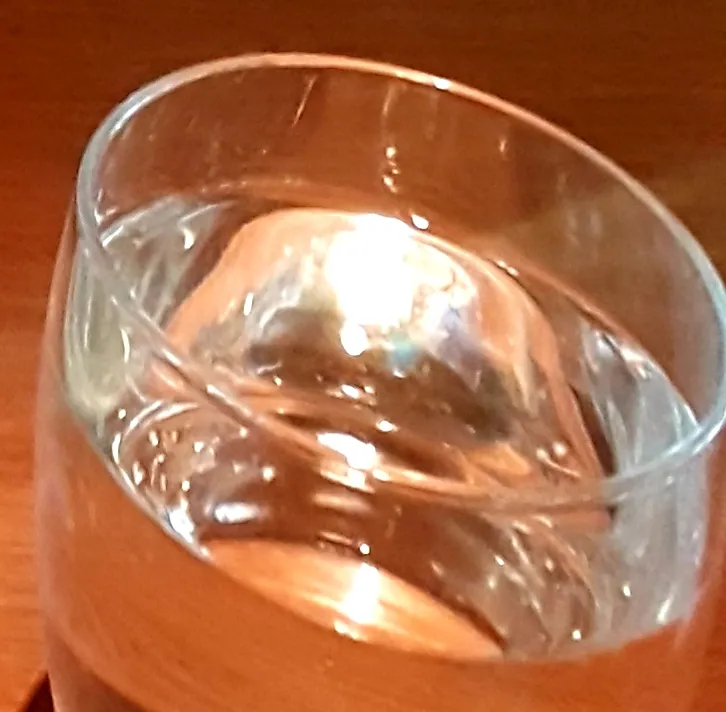
Photo: Mia Gaitanidis, CC BY-SA 4.0, via Wikimedia Commons
Set a clear glass of water on a sunny windowsill and you've built a laboratory. The light bending through it, the faint shadows it casts, the way a spoon half-submerged looks broken at the surface — all of it is the same physics that turns Lake Tahoe sapphire blue and lets NASA measure the health of the ocean from orbit.
Most of us think of water as the transparent background of the world. Optically speaking, it's anything but passive. Water is an active player in every photon's journey, and understanding its habits explains a surprising amount of what you see on any given trip to a lake, a coastline, or your own sink.
The Bend That Starts It All
The first trick water pulls is refraction. When light moves from air into water, it slows down — light travels about 25 percent slower in water than in air — and that change in speed makes the light's path kink. This is why the straw in your iced tea appears snapped at the waterline, and why a fish you spot in a creek is almost never exactly where it appears to be.
The bending angle depends on something called the refractive index, and water's is unusually high for a clear liquid. That's why a glass of water can act as a decent magnifying lens, why raindrops are so good at splitting sunlight into rainbows, and why your windowsill glass projects those curious curved caustics of light onto the countertop. Every one of those dancing bright lines is a map of light being redirected, drop by drop.
Where the Red Goes
Refraction bends light, but absorption removes it — and this is where water reveals its true colors. Literally.
Water molecules are remarkably good at absorbing red and orange wavelengths of light. It's a quirk of molecular vibration: the bonds in H₂O resonate with the energy of red light and quietly swallow it. Blue wavelengths, by contrast, mostly bounce around until they scatter back toward your eye.
Here's the catch: in a glass of water, or a puddle after a rainstorm, the light simply doesn't travel far enough for absorption to matter. A few inches of path length, and nearly all wavelengths survive. That's why puddles look clear — there just isn't enough water in the way to eat the red.
Scale up, though, and the effect becomes dramatic. Swim down ten feet in the Gulf of Mexico and the world shifts teal. Dive deeper and reds vanish first, then yellows, until everything is a deep, eerie blue. A blood-red glove at sixty feet looks nearly black. The water isn't dyeing anything; it's subtracting, wavelength by wavelength, with every foot of depth.
Why Lake Tahoe Isn't Just a Mirror
This absorption story explains one of the most common questions about lakes: is the water blue because it's reflecting the sky?
Sometimes, partly. But reflection alone can't explain why Lake Tahoe stays intensely blue under overcast skies, or why the blue persists even when clouds fill the horizon. The deeper truth is that pure water is intrinsically blue — not strongly blue, but blue enough that when light penetrates dozens of feet and returns to your eye, the reds have been filtered out and blue is what's left.
Clear mountain lakes like Tahoe or Crater Lake in Oregon show this best, because they lack the sediment and algae that muddy the effect. A farm pond in the Midwest, thick with algae, looks green instead — chlorophyll in the algae absorbs its own set of wavelengths and repaints the water. Color, in other words, is a readout of what's living and dissolving in the lake.
Reading the Ocean From 438 Miles Up
That last idea is powerful enough that we've built satellites around it. NASA's ocean-color missions measure the exact spectrum of light bouncing off the sea surface and, from that, infer what's underneath.
The logic works like this: open ocean with few phytoplankton scatters back mostly blue light. Waters rich in phytoplankton — the drifting algae that anchor marine food webs — return greener light, because chlorophyll absorbs blue and red while reflecting green. By mapping these subtle color shifts across whole basins, scientists track algal blooms, monitor fisheries, and watch climate-driven changes unfold season by season.
The same absorption coefficients measured in a lab beaker — the same numbers that describe your drinking glass — are baked into those satellite models. There's no special physics for the big scale. Water behaves the same whether the path length is four inches or four hundred feet. Only the arithmetic of accumulation changes.
Your Windowsill, Revisited
So go back to that glass. The bent straw is refraction. The brightness dancing on the counter is light being focused and redirected. If you could stack a thousand of those glasses into a column, you'd watch the red drain out of a flashlight beam from the top, one wavelength at a time.
Water doesn't get credit as an optical material the way glass or crystal does. But pound for pound, nothing on Earth shapes more of the light we see. It bends it, filters it, and — given enough depth — paints it blue. The ocean's color and the puddle's clarity aren't different phenomena. They're the same phenomenon, at different lengths of a ruler.