The Freezer Confessional: What Your Ice Cubes Are Trying to Tell You at Midnight
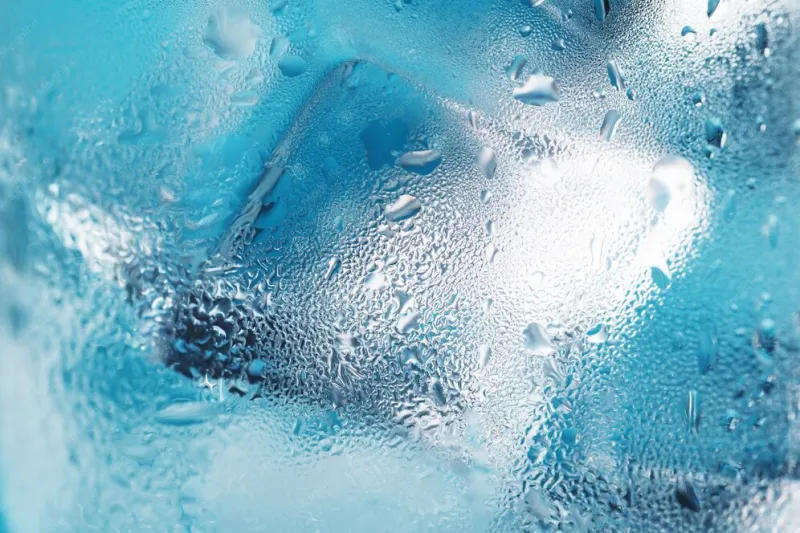
Photo: ice cubes cracking in glass of water close up macro, via img.freepik.com
It's usually the middle of the night when it happens. You're drifting off, the house is quiet, and then — pop — a sharp little crack from the kitchen, like someone snapped a twig two rooms away. Nothing is wrong. Nobody is in the house. It's just the ice.
Most of us file that sound under "house noises" and move on. But at Light & Water, we think every crack in an ice cube is worth interrogating, because it's one of the few places in your daily life where you can hear thermodynamics doing its work in real time. Let's take a cube apart — slowly — and see what it's been trying to tell you.
The Cube Freezes From the Outside In
Start with the tray. Your freezer's air is around 0°F (-18°C), and it attacks the cube from every surface at once. The outside freezes first, growing a shell of solid ice while the middle stays liquid for a surprisingly long time.
Here's where water shows off its most famous quirk: unlike almost every other liquid on Earth, it expands as it freezes — roughly 9% by volume. That's why ice floats and why a full water bottle left in the freezer bulges like a strained balloon. Inside your little cube, the last pocket of water to freeze is trapped in the center, surrounded by a rigid cage of already-solid ice. When that core finally turns solid and pushes outward, the cage has nowhere to go.
Something has to give. What gives is the ice itself — and the crack is the sound of that internal pressure releasing.
Three Noises, Three Stories
Not all ice sounds are the same, and each one has its own origin story:
- The pop. A short, sharp snap, usually soon after the tray goes in. That's the freezing core stressing the outer shell until a fracture zips through it. The crack propagates faster than your ear can follow, which is why you hear a single pop instead of a long tear.
- The crack. Longer and lower, often when you drop a cube into a drink. Now the temperature gradient flips: the outside is suddenly 70°F warmer than the inside, the surface tries to expand while the core is still frigid and rigid, and stress fractures race through the cube. Cracks hitting the liquid in your glass is why cold soda sometimes seems to hiss when ice goes in.
- The squeak. That faint groan from an old ice cube tray is friction — a plastic flexing against ice as materials with different shrink rates pull against each other in the cold.
Try This Tonight: The Thermal Forensics Experiment
You don't need a lab. You need a tray, a glass, and about an hour.
- Boil first. Fill a tray with water that's been boiled and cooled. Dissolved air is what makes ice cloudy; boiled water holds less of it, so your cubes will come out clearer — and slightly quieter, since fewer trapped air bubbles mean fewer weak points.
- Listen in stages. Put the tray in the freezer and check it at 30 minutes, then an hour, then two. The pops cluster early, when the core is still freezing. That timing is the experiment: you're mapping the freeze-front by ear.
- The drop test. Take two cubes — one from boiled water, one from tap — and drop each into a glass of room-temperature water. Note the difference in sound. The tap-water cube, riddled with air bubbles, usually cracks more dramatically. Those bubbles act like pre-made fault lines.
- Go extreme. Pour liquor (which stays liquid well below 32°F) over a cube and watch fine cracks spiderweb across the surface almost instantly. The temperature shock is so severe the ice fails on camera.
From Your Freezer to a Glacier
Now scale up. When a glacier in Alaska or on Montana's Glacier National Park's shrinking icefields heats up on a summer afternoon, the same physics runs at a scale you can stand on. Ice expands, stresses build, and fractures release — except instead of a pop, you get a seismic event. Researchers call them icequakes, and they're loud enough to register on instruments miles away. The crackling you hear when glacier ice calves into the sea is your ice cube's sound, amplified by a factor of billions.
The same expansion drives frost heave on American roads. Water seeps into pavement cracks, freezes, expands 9%, and pries the asphalt apart — which is why spring in Minnesota and Vermont brings a fresh crop of potholes. Your freezer, a glacier, and the road department's pothole budget are all running the same experiment.
One Last Listen
The next time the freezer cracks at midnight, resist the urge to write it off as the house settling. It's a pressure release valve, a mini icequake, a 9%-expansion demonstration — happening on your schedule, for free, in the dark.
Water is at its most talkative when it changes state. All you have to do is listen.