Six Feet of Sky: Why the Rainbow at the End of Your Hose Breaks All the Rules
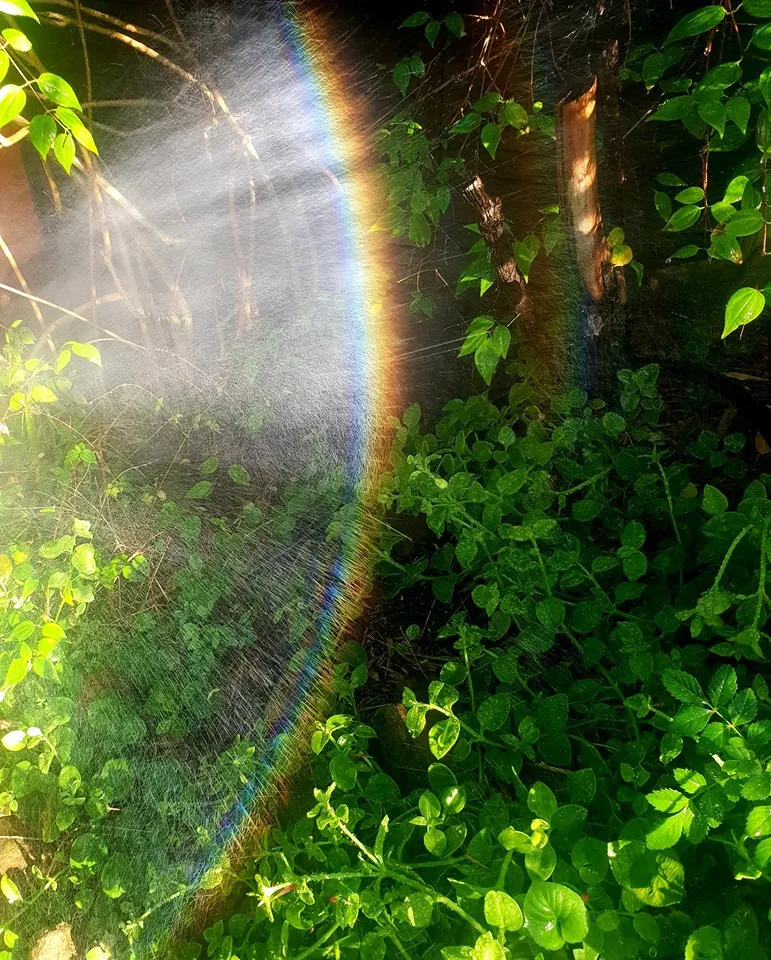
Photo: Photwik Photographer for Kiddle.co, CC BY-SA 4.0, via Wikimedia Commons
There's a moment every kid in America has had: you're running through the sprinkler on a July afternoon, you turn around, and there it is — a rainbow, small and stubborn, floating in the mist about ten feet behind you. Not arcing over the neighborhood. Just... there. Close enough to almost touch.
If you've ever wondered why that rainbow seems to break every rule the schoolbook rainbow taught you, congratulations. You've stumbled into one of the most approachable optics experiments in the world, and it runs itself every time someone waters their lawn.
The Sky Rainbow Is a Lie of Distance
First, a correction to your mental model: a rainbow is not an object located somewhere in the landscape. It's a direction. Every raindrop along a cone of directions 42 degrees away from the point directly opposite the sun is bouncing red light toward your eyes; every drop along a slightly tighter cone is bouncing violet. Your brain, which insists on pinning things down in space, paints the result onto the sky like a projection on a screen.
That's why you can never walk to a rainbow. The projection moves with you, because the geometry that builds it is anchored to your eyes, not to the terrain.
Now here's the twist: that anchoring is exactly why the sprinkler rainbow can sit six feet away. The drops making it are six feet away. The projection screen is wherever the mist is. A rainbow has no minimum distance — only a minimum angle.
Why the Backyard Version Looks Wrong
Compare the two side by side and the differences stack up fast.
It's smaller. A rain-shower rainbow can span enormous stretches of sky because the shower is huge. Your sprinkler's fan of droplets is maybe ten feet across, so the visible slice of the 42-degree cone is a sliver. You're seeing a genuine rainbow, just through a keyhole.
It might be a full circle. From an airplane, rainbows are complete rings, because nothing blocks the lower half of the cone. Stand close to a fine mist on a sunny morning and you can sometimes reproduce that view from the ground: with mist all around you and no ground in the way of the geometry, the arc closes into a circle around the shadow of your head. Every rainbow you've ever seen is secretly that circle. The sprinkler just lets you see the punchline.
It's brighter and oddly colored. Storm droplets are roughly a millimeter across. Sprinkler mist is finer — often a tenth of that or less — and droplet size changes the physics. Smaller drops bend and overlap light differently, washing the bands together and sometimes producing supernumerary bows: faint pastel fringes of pink and green hugging the inside of the arc, caused by light waves interfering with themselves after taking slightly different paths through each drop.
Supernumeraries do show up in real skies, usually in the pale bows that follow a passing drizzle. But in fine, uniform mist they're easy to find on demand. It's one of the few places interference — the same phenomenon that makes soap bubbles swirl — shows up in something as mundane as lawn care.
Your Saturday Morning Experiment
You need three things: a garden hose with an adjustable nozzle, a sunny day with the sun fairly high, and ten minutes.
- Set the nozzle to the finest mist it makes — think fog, not spray.
- Stand with the sun at your back and sweep the mist slowly across your view until the bow appears. Notice how it slides when you step left or right. You're watching the geometry re-anchor to your eyes in real time.
- Walk toward the mist and watch the bow brighten and tighten. If the mist is fine and even, look just inside the violet edge for those soft pink-and-green supernumerary bands.
- Now find your shadow. The center of any rainbow circle always sits exactly opposite the sun — which means it lines up with your shadow's head. Sprinkler mist is one of the only ways to see the full circle without a plane.
- Bonus round: adjust the nozzle to bigger drops and watch the supernumeraries vanish while the main colors sharpen. You've just demonstrated, with a $12 hose attachment, why meteorologists can estimate droplet size in distant clouds just by reading the rainbow.
The Takeaway
The sprinkler rainbow isn't a lesser imitation of the real thing. It's the same physics with the variables turned into dials: distance you control, droplet size you control, circle you can finally see whole. Storms give you one configuration and call it a day. Your hose gives you the whole parameter space.
That's worth remembering the next time you're out there getting soaked on purpose. You're not just cooling off. You're running the experiment the sky only lets you audit.