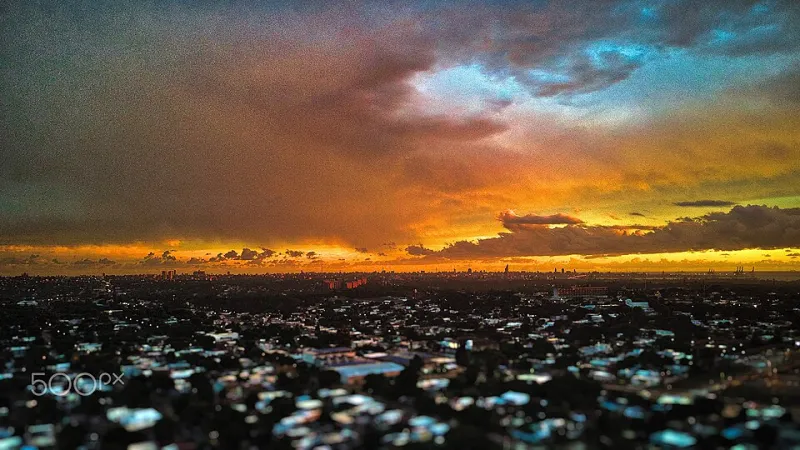
Five Spots in Your Neighborhood Where Light and Water Are Running Experiments
Photo: Riverhugger, CC0, via Wikimedia Commons
Physics has a reputation for requiring expensive equipment. It doesn't. Some of the best optics demonstrations on Earth happen in your yard, your pool, and your windshield — free of charge, running on repeat. Here are five to catch, plus how to make each one happen yourself.
1. The Rainbow Sprinkler
On hot summer afternoons across the suburbs, lawn sprinklers quietly stage one of nature's best demos. When fine water droplets hang in the air with the sun behind you, a small rainbow can appear in the mist.
The principle: dispersion. Each droplet refracts (bends) light entering it, reflects it off the back, and refracts it again on the way out. Because each wavelength bends a slightly different amount, the colors fan out — red on the outside, violet on the inside. A million droplets each contribute one tiny gleam, and your brain stitches them into a bow.
Try it: On a sunny day, stand with your back to the sun and let a garden hose set to "mist" spray in front of you. Adjust the angle until a rainbow blooms. Move slightly left or right and watch it move with you — proof that the rainbow isn't an object. It's geometry between you, the sun, and the spray.
2. The Swimming Pool's Moving Lace
Look at the bottom of a pool on a sunny day and you'll see shimmering nets of light — bright, wiggling lines dancing across the floor. These are caustics, and they're refraction made visible.
Sunlight bends as it enters the rippling water surface. Each wave acts like a wobbly lens, concentrating light into bright lines and stealing it from the dark gaps between. The pattern is so sensitive that pool-floor caustics are essentially a live readout of the surface's shape.
Try it: No pool needed. Hold a clear glass of water a few inches above a countertop in sunlight and watch the light pattern it casts. Slowly tilt the glass — the caustic stretches, snaps into a bright line, and swings around. You're bending light with your hand.
3. Dew on a Spiderweb
Early morning dew turns an invisible spiderweb into a string of tiny lenses, each bead catching the sunrise. It's one of the prettiest free shows in nature — and there's real physics in each drop.
Water molecules cling to each other (cohesion) and to the silk (adhesion), pulling each droplet into a near-perfect sphere. That spherical shape makes each bead a miniature magnifying lens. Light refracting through thousands of them at once turns the whole web into a glowing necklace.
Try it: On a dewy morning, crouch low so the sun is behind the web — backlit beads glow brightest. Or make your own web effect: mist a window screen with water at dawn and watch the beads form and light up. A spray bottle and patience are all it takes.
4. Rain on the Windshield
Night driving in the rain is an optics masterclass whether you asked for it or not. Every drop on the glass is a tiny lens, and every oncoming headlight becomes a smeared star.
The principle: refraction plus a touch of dispersion. A raindrop bends light from headlights, spreading each point source into a soft, stretched blob — which is exactly why you should never rely on judging distances in heavy rain. And when drops sit still on the glass, they can act like prisms, briefly flashing tiny spectra from streetlights.
Try it: Park safely, turn on the hazard lights, and look at a single streetlight through a rain-beaded window. Focus on one drop. Notice how it flips the light upside down inside itself — a pinhole-camera-style inversion, courtesy of a water droplet. (Then, for safety's sake, let the wipers do their job while driving.)
5. The Lake Glare at Dusk
Anyone who's stood on the shore of Lake Michigan or a mountain lake at sunset knows the golden path of light stretching across the water toward you. That glare is a reflection puzzle.
Water reflects light far better when light arrives at a shallow angle — which is exactly what happens at dusk. Ripples scatter the reflection into a long, shimmering streak pointing straight at you. Notably, that glare is partially horizontally polarized light, which is why polarized sunglasses — which block horizontal polarization — make the lake suddenly look deep and clear when you put them on.
Try it: Next time you're near any reflective surface — lake, puddle, car hood — rotate a pair of polarized sunglasses in front of your eyes while looking at the glare. The shine fades and returns as you turn them. You're literally watching the orientation of light waves with your own eyes.
Keep Looking
The thread running through all five is the same: light and water are constantly negotiating, bending, bouncing, and splitting wherever they meet. Once you start noticing caustics on the kitchen counter or the polarized shimmer off a puddle, it's hard to stop. The physics was always there. Now you've got the cheat sheet.