One Photon's Road Trip: How Sunlight Paints the American Sky
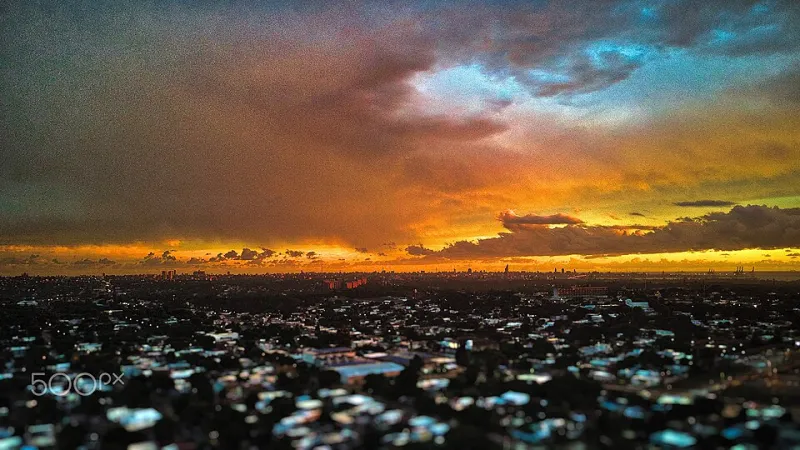
Photo: Marcelo Campi, CC BY-SA 3.0, via Wikimedia Commons
Picture a photon named Sunny. It was born in the sun's core roughly 100,000 years ago, bounced around for millennia, and finally broke free into space. Eight minutes later, it reached Earth. What happened next is the reason your sky is blue at noon and orange at dinner.
The Long Blue Answer
Sunny's journey began innocently enough. Sunlight looks white, but it's really a crowd of colors traveling together — a full rainbow's worth of wavelengths packed into one beam. Violet and blue light travel in short, choppy waves. Red light cruises along in long, lazy ones.
When that beam hits our atmosphere, it collides with nitrogen and oxygen molecules — tiny obstacles far smaller than the waves of light themselves. And here's the key: short wavelengths scatter off these molecules far more strongly than long ones. Physicists call it Rayleigh scattering, and the effect is dramatic. Blue light scatters roughly five and a half times more than red.
So when Sunny — a blue-leaning photon — smacked into an air molecule over Kansas, it ricocheted sideways, then sideways again, bouncing across the sky like a pinball. By the time it reached your eyeball, it could have arrived from almost any direction. That's the trick: the blue you see overhead isn't a beam pointing at you. It's billions of scattered photons converging from everywhere at once.
Why Not Violet, Then?
If short waves scatter best, shouldn't the sky be violet? Partly, yes — but the sun emits less violet than blue, our eyes are less sensitive to it, and some violet gets absorbed high up. The blend of scattered colors that survives lands squarely on our retinas as sky blue. The sky's color is a collaboration between physics and human eyesight.
Sunset: The Long Way Around
Now rewind and follow a different photon — call her Ruby — a red-leaning traveler riding in the same beam of sunlight.
At noon, Ruby's path is short. She punches through maybe 10 miles of air overhead, loses a little blue company along the way, and lands as plain old white-ish daylight.
But at sunset, everything changes. The sun sits low, and its light now grazes the horizon, slicing through hundreds of miles of atmosphere — air over the Rockies, over the plains, over your neighbor's roof. That's a much longer gauntlet. Nearly all the blue photons get scattered away long before arrival. Ruby, unbothered by all that scattering, sails straight through to your eyes.
The sun doesn't change color at dusk. It just runs out of blue.
When Smoke Turns Up the Volume
Here's where things get very current for anyone in the American West. Wildfire smoke — from California to Colorado to the Pacific Northwest — loads the atmosphere with particles larger than air molecules. These don't scatter by Rayleigh's rules; they scatter all wavelengths more evenly and block more light overall.
The result? Sunsets that look almost unreal. With even more blue filtered out, the reds and oranges that survive grow deeper and more saturated. Some smoke-tinged sunsets glow crimson or even purple. It's a strange silver lining: the same haze that clogs your lungs and dims the sun also stages the most vivid sunset of your year. (Scientists even use the purple haze after big volcanic eruptions to study the atmosphere — the physics works the same way.)
A quick note of honesty: pollution and smoke don't always mean prettier sunsets. Heavy haze can mute everything into a dull gray-orange. The best shows happen when smoke sits high in the atmosphere while the air near the ground stays clear.
Try This Tonight
You don't need a lab to see Rayleigh scattering yourself.
- Fill a clear glass with water and stir in a drop or two of milk.
- Shine a flashlight through the glass in a dark room.
- Look at the side of the glass: it glows faint blue — scattered short wavelengths, just like the sky.
- Look at the light coming out the far end: it's shifted toward orange or red — the beam that lost its blue, just like a sunset.
One glass of milky water, and you've recreated the entire sky.
The next time you're stuck in traffic at dusk watching the horizon burn orange, give a small nod to Ruby. She traveled 93 million miles and ran a几百-mile gauntlet of air to get to your retina. Sunny, meanwhile, is somewhere overhead, still bouncing around, making the afternoon blue.