A Candle in, a Searchlight Out: The Glass Trick That Lit America's Coastlines
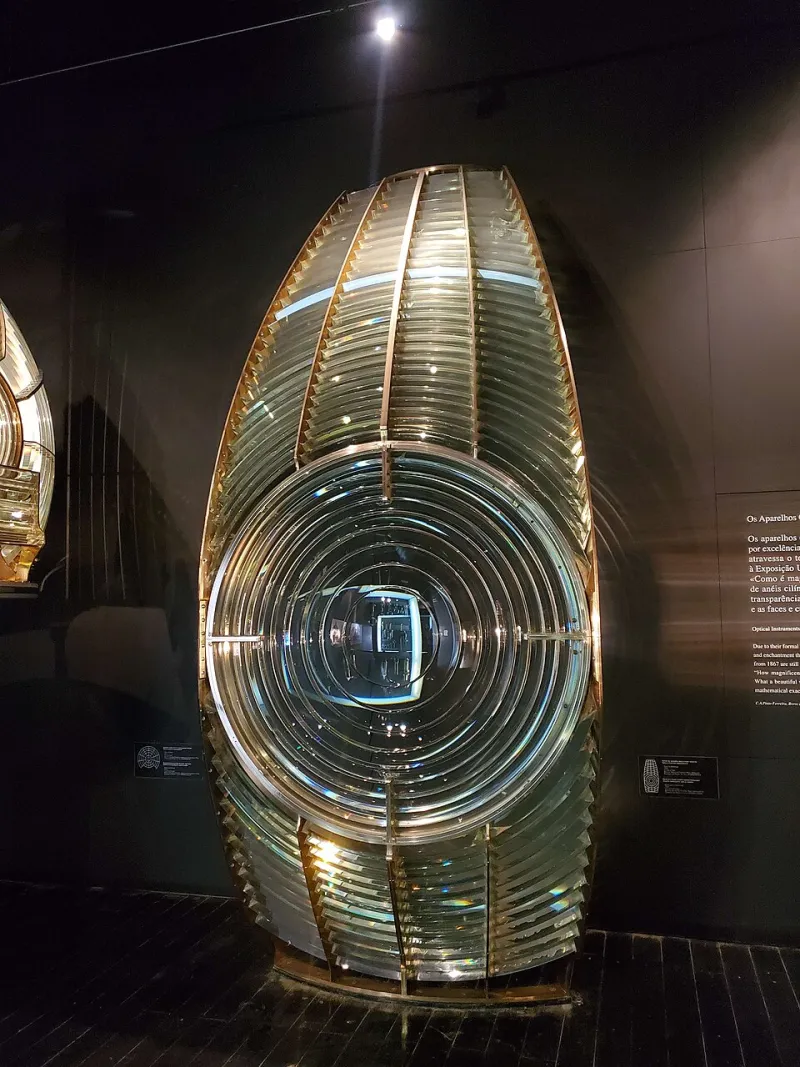
Photo: Lighthouselover143, CC BY-SA 4.0, via Wikimedia Commons
The Problem With Fire
A flame doesn't care which direction it glows. It spills light evenly in every direction, which is wonderful if you're trying to illuminate a room and terrible if you're trying to warn a ship captain that there's a shoal three hundred yards ahead of the bow.
For most of maritime history, that was the lighthouse keeper's dilemma. Burn a bigger fire and you get a brighter light — but you also burn through astonishing amounts of fuel. Colonial American lighthouses, like the one at Boston Light dating to 1716, consumed whale oil by the barrel. And even the biggest flames, reflected and aimed as best as the era's mirrors allowed, produced beams that faded into the haze long before a navigator at the horizon could use them.
The math was brutal. Light intensity falls off with the square of distance. Double the range and you need four times the brightness. Triple it, and you're at nine times. No amount of whale oil was going to get a candle's worth of flame to the twenty-mile mark.
What it needed wasn't more fuel. It needed better glass.
A French Physicist With a Grinding Problem
Augustin-Jean Fresnel was, by trade, a physicist and engineer — a specialist in how light waves bend and interfere. In 1822, the French government asked him to solve the lighthouse problem, and he approached it the way he approached everything: by thinking carefully about what light actually does.
A conventional lens — the kind in eyeglasses or a magnifying glass — works by bending light as it passes through curved glass. But a large, thick lens is heavy, hard to make, and absorbs a surprising amount of light in the process. Fresnel's insight was that only the surface curvature of a lens matters for bending light. The bulk of the glass in the middle is dead weight.
So he sliced the idea apart. Imagine taking a conventional lens, cutting it into a series of concentric rings, and flattening each ring back toward a central plane. You lose nothing optically — light still bends at each ring's curved surface — but you gain a lens a fraction of the thickness and weight. For a lighthouse, this was everything. A Fresnel lens could be big, light enough to rotate, and thin enough that a modest oil lamp behind it could shine through without being swallowed by the glass.
The first Fresnel lens went into service at Cordouan Lighthouse at the mouth of the Gironde River in 1823. Sailors reported seeing a beam that looked impossibly bright for the modest flame producing it. Word traveled fast.
America Comes Around Slowly
Here's a fun bit of national stubbornness: the United States, despite having more coastline than almost anyone, resisted Fresnel lenses for decades. The Treasury Department's Fifth Auditor, Stephen Pleasonton, oversaw American lighthouses from 1820 to 1852 and saw no reason to adopt fancy French optics. American lights soldiered on with Argand lamps and parabolic reflectors — technology that was already obsolete in Europe.
Pleasonton's retirement, and a string of shipwrecks that made the newspapers, finally forced change. Congress reorganized lighthouse administration, and by the late 1850s Fresnel lenses were being installed up and down the American coast. Cape Hatteras, Cape Flattery, Point Reyes, the reefs of the Florida Keys — suddenly every light station in the country could throw a beam that a ship's officer could actually trust.
The Big, the Small, and the Dazzling
Not all Fresnel lenses are equal, and lighthouse people grade them the way jewelers grade diamonds. The system is called "order," and it describes the focal distance — how far the lens sits from the light source.
First-order lenses are the giants. Some stand twelve feet tall and weigh several tons, with bull's-eye panels of prism glass arranged in a cylinder. These went on the most dangerous coastal stations, where a light needed to reach twenty or more miles. Second, third, and fourth orders shrink from there, down to small harbor and river lights. Each size matched a job, and the whole coastline was catalogued accordingly.
The craftsmanship involved is staggering. These lenses weren't cast — they were ground and polished by hand, prism by prism, often in French workshops like those of the Lepaute and Barbier families. A single first-order lens might contain over a thousand individual pieces of glass, each angled to within fractions of a degree. Get one wrong and the beam has a hole in it.
Why Every Lighthouse Flashes Differently
The most elegant part of the Fresnel system isn't the brightness. It's the pattern.
Early lighthouses had a problem: out at sea, one white flash looks much like another. If two lighthouses sit within sight of each other, a navigator can't tell which one they're looking at — and on a dark, foggy night, that confusion kills.
The solution was to give every lighthouse a signature. Fresnel lenses were built with rotating machinery — later clockwork, driven by weights the keeper cranked up like a grandfather clock — that spun the lens around the lamp. Some lenses were built with flashing panels; others had fixed sections with red or green sectors. The result was a unique rhythm: one light might flash every four seconds, another might show a fixed beam punctuated by a flash every fifteen, another might alternate red and white.
These patterns were printed in the Light List, a government publication that mariners still carry today. The patterns are called "characteristics," and they're why a lighthouse is never just a lighthouse. It's a name, written in light, that a navigator can read from the deck of a moving ship.
Some of the old clockwork mechanisms are still in operation. Keepers used to wind them by hand every few hours; at a handful of stations, the weight still descends slowly through the tower, driving the lens around in the same rhythm it has kept for a century and a half.
Where You Can See One Up Close
You don't need a boat. Fresnel lenses survive in museums and working lighthouses across the country, and they're worth the trip purely as objects — the glass has a jeweled, almost liquid quality that photographs never quite capture.
The Coast Guard's National Museum in Washington, D.C., and the Maine Lighthouse Museum in Rockland hold impressive collections. The Point Arena Lighthouse in California has a first-order lens you can stand inside. Cape Hatteras, the Florida Keys, and the Door County Maritime Museum in Wisconsin all display lenses that once guarded real ships. Some — like the lens at Oregon's Cape Meares — are original installations, still spinning in the tower where they were mounted in the 1800s.
Stand close and look at the surface of the glass. You'll see the concentric rings Fresnel invented, each one a tiny prism doing its part to bend a flame's flicker into a line of light that crosses the water like a drawn sword.
The Physics in Your Kitchen
Here's the part that makes Fresnel lenses worth caring about even if you never visit a coast: the same principle is probably within arm's reach of you right now.
The plastic sheet on the back of a bus or RV window, the flat magnifier some people keep over a page of fine print, the screen on an old rear-projection TV — those are all Fresnel lenses, manufactured by molding the same ring pattern into plastic. The idea that seemed radical in 1822 is now so cheap it's disposable.
Fresnel himself died young, at 39, having never seen his lens transform an entire nation's coastline. But every time a lighthouse beam sweeps across a dark harbor — flashing its own private rhythm, visible from twenty miles out — you're watching his physics do exactly what he designed it to do: take something small and bright, and make it impossible to miss.