Double Exposure: The Hidden Physics Behind a Lifeguard's Sore Eyes
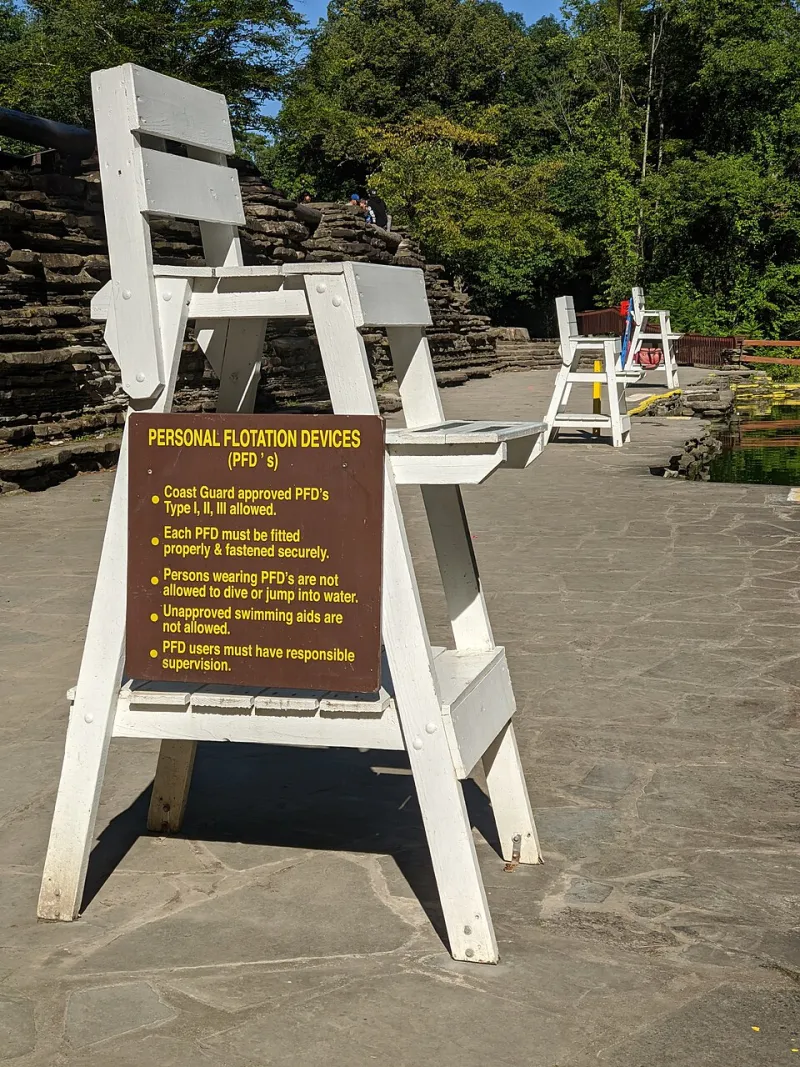
Photo: DanielPenfield, CC BY-SA 4.0, via Wikimedia Commons
Ask any seasoned lifeguard about the end of a long July shift and you'll hear the same complaint: gritty, watery eyes that feel like they've been scrubbed with sandpaper. It's so common in the profession that guards have a name for it — the eyeburn — and it's not just tiredness. It's a real, diagnosable condition called photokeratitis, and the swimming pool is one of the best machines ever built for producing it.
What's Actually Happening in There
Photokeratitis is, in the most literal sense, a sunburn. But not where you'd expect it. The cornea — the clear dome at the front of your eye — absorbs ultraviolet radiation the same way your skin does, except it has no protective layer of dead cells or melanin to blunt the hit. A few hours of intense UV-B exposure inflames the cornea's surface, producing pain, tearing, light sensitivity, and the distinct sensation that something is stuck under your eyelid.
The good news is that it's usually temporary; the cornea heals remarkably fast. The bad news is that repeated episodes add up, and ophthalmologists have linked cumulative UV exposure to long-term problems including pterygium (a fleshy growth over the cornea, sometimes called surfer's eye) and an elevated risk of cataracts later in life.
So why do lifeguards and competitive swimmers get hit harder than the rest of us? The answer comes down to geometry — and to water itself.
The Pool Is a Mirror With a Bad Attitude
Direct sunlight is only half the story. Water reflects roughly 10 to 30 percent of the UV light that strikes it, depending on the angle of the sun. At low sun angles, that reflectivity climbs even higher. That means anyone sitting at the edge of a pool is getting UV from two directions at once: straight from the sky above, and bouncing up off the surface below.
This is the same basic physics behind the classic advice to wear sunscreen on your chin during a beach day, but the pool version is more intense for a few reasons.
First, the geometry is brutal. A lifeguard in an elevated chair faces downward, scanning a large reflective surface for hours. The water acts like a broad, slightly wobbly mirror aimed directly at the most UV-vulnerable tissue in the body. The cornea sits at the front of the eye with no shade, no angle of reprieve.
Second, there's the glitter effect. A pool surface isn't flat; it's a field of chop and ripples, each facet catching sunlight and flashing it in a different direction. Some researchers call this the "sunglint" effect — thousands of tiny reflections that collectively scatter UV across a huge range of angles. You don't have to be looking at the water to catch the bounce; it finds you.
Third, add altitude and latitude. Many American public pools sit in Sun Belt states — Arizona, Texas, Florida, Southern California — where summer UV indices regularly hit 10 or higher. A guard working a full day in Phoenix is soaking up reflected and direct UV at rates that would make a dermatologist wince, and the cornea gets no vacation from it.
What the Guarding Industry Is Figuring Out
The organizations that train American lifeguards — including the American Lifeguard Association and programs run through the American Red Cross — have increasingly flagged UV exposure as an occupational hazard, alongside the better-known risks of dehydration and heat exhaustion. Recommendations circulating in the guarding community include rotating guards off high-glance positions every 30 to 60 minutes, providing shaded posts where facilities allow, and treating eye protection as equipment rather than an afterthought.
Some pools have also started scheduling "sun breaks" — short rotations into shaded areas, mirroring what ski patrols do on the slopes. It's the same logic: snowfields and pool decks both bounce UV, and both industries have learned that exposure management beats treatment.
A Practical Protection Playbook
If you're a parent of a teenage guard, a swim-team family, or just someone who spends June through August at the neighborhood pool, here's what actually helps:
UV-blocking sunglasses for guards. Not fashion shades — look for lenses labeled UV400 or 100 percent UVA/UVB blocking. Wraparound styles cut the glare that sneaks in from the sides, which matters when half your exposure is coming off the water.
Hats with brims, not visors. A wide brim shades the eyes directly and reduces the amount of light reaching the face at all. Lifeguards in Australia, where skin-cancer awareness runs decades ahead of ours, have been modeling this for years.
Swim goggles that actually block UV. Recreational goggles vary wildly in quality. If your kid is on a summer swim team, check whether the goggles specify UV protection — clear polycarbonate lenses often do, but cheap ones may not.
Timing matters. UV intensity peaks between roughly 10 a.m. and 4 p.m. If you're choosing when to do laps, earlier or later sessions cut exposure dramatically — and the reflections scale down with the direct sun.
Don't skip cloudy days. Up to 80 percent of UV penetrates light cloud cover, and water reflects it just the same. Overcast pool days still deliver a dose.
The Bigger Picture
There's something a little poetic about the whole situation. Light and water — the two things that make a swimming pool so pleasant in the first place — are exactly the combination that turns a summer job into an eye-health hazard. The sparkle on the surface that makes a pool look inviting is, from a photon's point of view, a delivery system.
None of this means anyone should quit the pool. Photokeratitis is almost entirely preventable with cheap, boring interventions: sunglasses, brims, shade rotations, and a little awareness. The guards who've been quietly wearing wraparounds for twenty years figured it out. The rest of us can catch up — ideally before the next cloudless Saturday.